
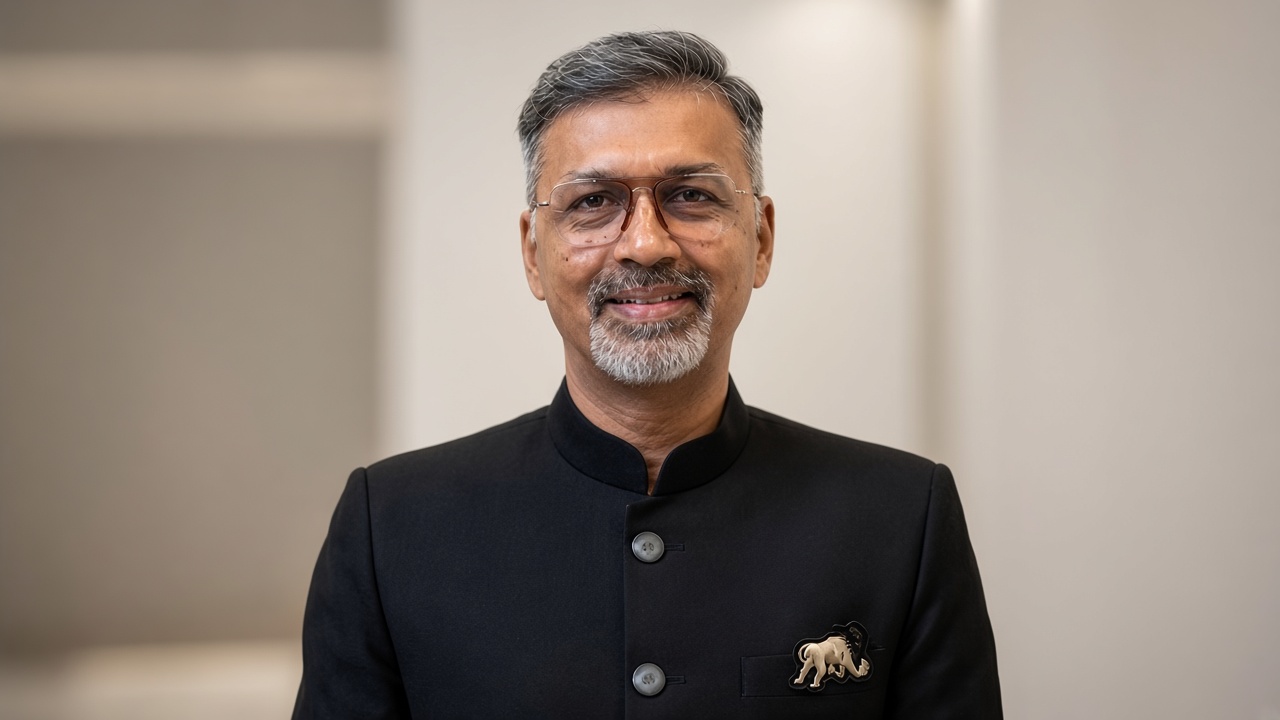
What made you want to do the work you do? Please share the full story.
I got into yoga in 1999 not for the physical benefits everyone talks about, but because I wanted to understand what was actually happening to the body and mind from a more rigorous, almost scientific angle. That curiosity led me to the Ishwardas Chunilal Yogic Health Centre in Mumbai, where I completed my Advanced Diploma and picked up training in acupressure alongside it. The deeper I went, the more I realized yoga couldn’t be separated from philosophy, so I pursued a B.A. in Yoga Shastra at K. J. Somaiya College and later a master’s in Philosophy from Mumbai University, work that eventually pulled me into researching Kautilya Arthashastra as well. Teaching became the natural extension of all that study, first as a personal trainer, then through international teacher training programs in the USA, Singapore, Bali, and Sri Lanka, and eventually as an examiner for the Yoga Certification Board. For me it was never about exercise, it became a lifelong education I wanted to pass on.
Tell us 3 surprisingly easy and 3 surprisingly difficult things about your business.
Surprisingly easy has been earning trust quickly with serious students, once they learn I’m an E-RYT 500 and YCB examiner, they tend to commit fully without much convincing, since the credentials speak for themselves. Building relationships with international training programs was also easier than expected, teaching in Bali and Sri Lanka opened doors to other countries almost organically through word of mouth among instructors. And surprisingly, balancing my own academic research with teaching turned out to be less draining than I assumed, the philosophy work actually sharpens how I explain concepts in class rather than competing for my time.
What’s been harder than expected is convincing some students that yoga is not a quick fitness fix, unlearning that mindset takes longer than teaching the postures themselves. Keeping up with the administrative side of running teacher training cohorts across different countries and time zones has also been more demanding than the teaching itself. And pursuing a Ph.D. while actively teaching and examining has been far more time consuming than I anticipated, balancing original research with a full teaching schedule leaves very little room for anything else.
What are the 3 things you like best about your work and why?
I like watching a student shift from treating yoga as exercise to understanding it as a way of life, that transition is usually the most rewarding part of any training I run. I also enjoy the examiner role with YCB, because it forces me to stay sharp about standards across the entire field, not just my own classroom. And I genuinely love the research side, digging into something like Kautilya Arthashastra and finding unexpected connections to yoga philosophy keeps the work intellectually alive for me, not repetitive.
What are your greatest 3 skills and how have they helped you succeed?
My depth in yoga philosophy, built through my M.A. and ongoing Ph.D. research, lets me teach the physical practice alongside its actual meaning, which sets my training apart from a purely postural approach. My experience as a YCB examiner sharpened my ability to evaluate teaching quality precisely, which makes my own certification programs more rigorous than most. And having taught internationally across the USA, Singapore, Bali, and Sri Lanka gave me the adaptability to teach students from very different cultural starting points without losing what makes the practice authentic.
Tell us about a time you were dead wrong about something.
Early in my teaching career I assumed that the more advanced postures and sequences I demonstrated, the more credibility I’d build with students. I was wrong. A batch of teacher trainees once told me directly that they were more confused than inspired, they wanted to understand the why behind a simple pose before moving to anything complex. That feedback completely changed how I structure my trainings now, I lead with philosophy and foundational understanding before layering in advanced technique, and the retention and actual teaching quality of my graduates improved noticeably once I made that shift.
What is the biggest challenge you face each day and how do you handle it?
The biggest challenge is managing time across teaching, examining, and my own Ph.D. research, all of which demand full attention and none of which I want to shortchange. I handle it by keeping strict blocks in my week, research mornings, teaching and examining in structured sessions later in the day, so that one area doesn’t quietly consume the others. It’s not perfect, but it keeps all three moving forward instead of one taking over.
What do you value most and why?
I value lifelong learning above almost everything else in my work. I’ve never stopped studying since 1999, moving from my Advanced Diploma at ICYHC through a B.A., an M.A. in Philosophy, and now a Ph.D., and that continuous curiosity is what keeps my teaching from going stale. The moment a teacher stops learning, the students feel it, so staying a student myself is non-negotiable for me.
What achievement are you the proudest of and why?
Becoming a Yoga Certification Board examiner is what I’m proudest of, because it means I’m not just teaching to a standard, I’m helping define what that standard is for other instructors across India. Reaching E-RYT 500 status alongside that gave me the credibility to train teachers internationally, but the examiner role specifically is what lets me shape the quality of the field beyond my own classroom.
Who is your favorite motivational speaker and why?
I don’t really follow motivational speakers in the traditional sense. The people who’ve actually moved me have been my own teachers at ICYHC and throughout my academic training, people who taught through patience and depth rather than a stage performance. That kind of quiet, sustained guidance has shaped me far more than any single speech ever could.
What advice would you give to your younger self and why?
I’d tell my younger self to slow down on advanced technique and spend more time on philosophy first. I used to think impressing students with complex postures was the fastest way to earn their respect, but I later learned trainees wanted to understand the reasoning behind a pose before advancing, and that lesson would have saved me years of restructuring my teaching approach.
Who has been your biggest mentor in life (personal or professional) and how have they helped you?
My teachers at the Ishwardas Chunilal Yogic Health Centre, where I earned my Advanced Diploma, shaped my entire approach to yoga. They treated the practice as a serious discipline worth rigorous study rather than a wellness trend, and that mindset is the reason I went on to pursue a B.A., M.A., and now a Ph.D. in the subject instead of stopping at a teaching certificate.
Give us words of wisdom. What is one thing your Mom or Dad taught you remember to this day?
My father always told me that real knowledge is only worth something once you pass it on to someone else. That idea stuck with me long after I left home in Mumbai, and it’s the reason teaching became the center of my work rather than just practicing yoga privately for myself.