
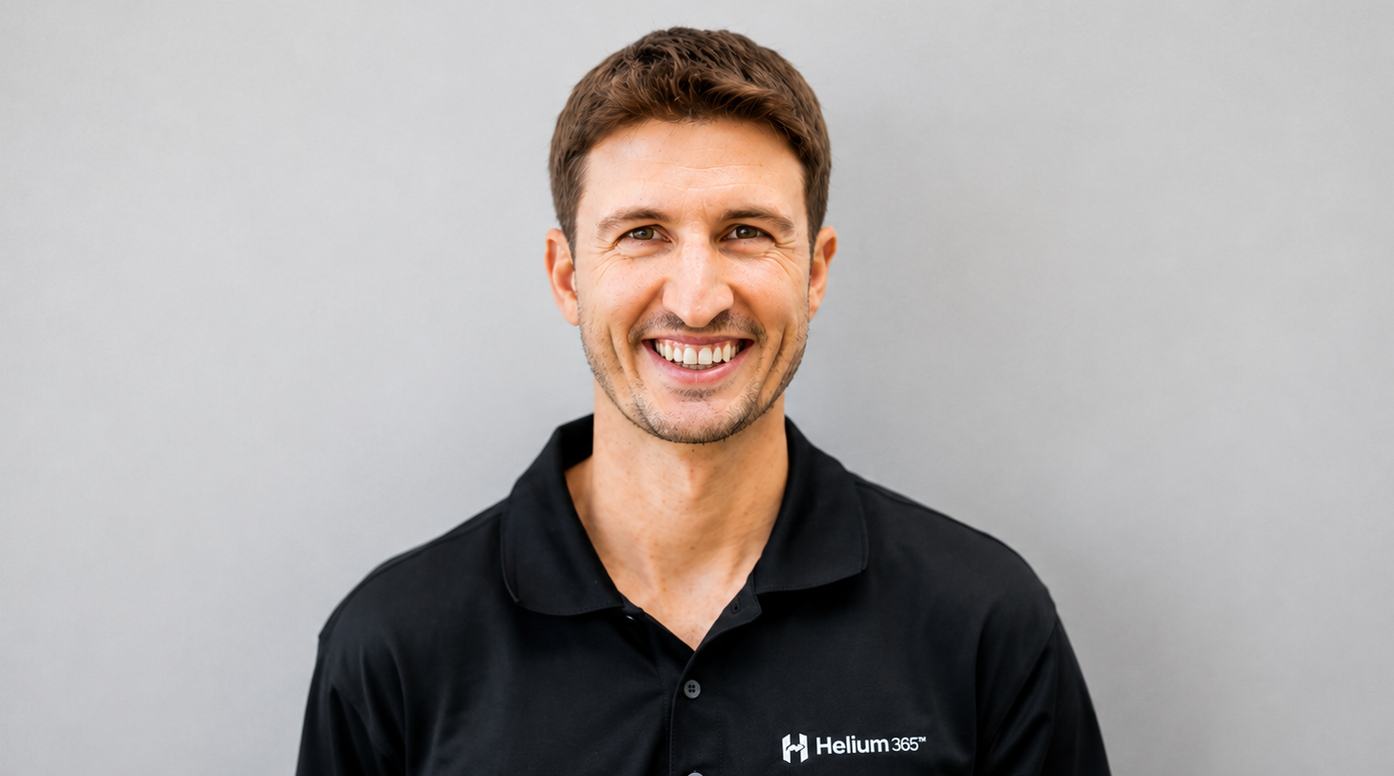
What made you want to do the work you do? Please share the full story.
I started coding at 14, building small tools just to see if I could make something work end to end. That habit of tinkering carried into college, where I paired computer science with an unexpected interest in how search engines actually rank content. The first time I changed a title tag on a client site and watched the rankings shift within days, something clicked. SEO wasn’t marketing to me, it was a system with inputs and outputs, and I wanted to understand the machine well enough to predict it.
That curiosity is what led me to build NobleSEO.io and later H1seo.io, tools born out of frustration with manual, guesswork-driven SEO work. I kept hitting the same wall: agencies were spending hours on backlink outreach with no way to know which links would actually move the needle. So I built a system to predict that before the money was spent. Helium SEO grew out of wanting to apply that same engineering mindset at scale, treating marketing less like an art and more like a discipline you can measure and improve.
How is AI changing your business? What changes are you making to adapt?
AI has moved from being a nice-to-have research tool to being embedded directly in how we do the work. Two years ago, our team was writing content briefs by hand and manually clustering keywords into topics. Now our NLP models handle entity extraction and topic clustering in minutes, which means our strategists spend their time on judgment calls instead of data entry. The backlink prediction system I built years ago runs constant retraining cycles now, since Google’s algorithm signals shift and a static model goes stale fast.
The bigger adaptation has been cultural, not technical. We had to retrain account managers to trust model output for the repetitive 80 percent of the work while reserving human judgment for the 20 percent that actually requires it, like reading client intent or spotting an edge case the model hasn’t seen. We also had to build validation layers into every AI-assisted deliverable, because a model that’s wrong with confidence is worse than a slow human who admits uncertainty.
If AI is impacting your business, please tell us 3 things you expect to change in the near future.
First, keyword research as a standalone service is going to shrink. Once search engines answer questions directly through AI overviews, ranking for a keyword matters less than being cited as a source, so our roadmap is shifting toward entity authority and structured data that AI systems can pull from directly. Second, content production timelines will keep compressing, but the bottleneck will move to fact-checking and originality verification, since AI-generated content is only valuable if it says something a model couldn’t already generate on its own.
Third, attribution is going to get harder before it gets easier. As AI search interfaces summarize answers without sending a click, traditional analytics will undercount real influence, and agencies that don’t build new measurement models around AI-driven visibility will be flying blind within 18 months. We’re already testing ways to track brand mentions inside AI-generated answers, not just clicks from traditional search results.
What are your greatest 3 skills and how have they helped you succeed?
My strongest skill is pattern recognition across disciplines, specifically the ability to see a marketing problem and immediately think in terms of data structures and models rather than tactics. That’s what led to the backlink prediction system, since I didn’t approach it as an SEO problem, I approached it as a regression problem with SEO inputs. It cut wasted outreach by more than 60 percent because I was solving for the actual variable that mattered, predictive ranking value, instead of chasing domain authority scores that only loosely correlate with results.
My second skill is full-stack execution, meaning I can go from idea to working prototype without waiting on someone else to build it. That speed compresses the gap between having an insight and testing whether it’s real. My third skill is translating technical complexity into decisions non-technical clients can act on, which matters more than the engineering itself, because a brilliant model nobody trusts or understands never gets used.
Tell us about a time you were dead wrong about something.
Early on I was convinced that domain authority was the strongest predictor of link value, so the first version of my backlink model weighted it heavily above almost everything else. We ran a batch of outreach based on that model and the results were mediocre at best, with several high-DA links producing zero ranking movement for clients. It forced me to go back and actually test the assumption instead of trusting the industry consensus I’d absorbed without questioning.
What I found was that contextual relevance and topical proximity to the linking page mattered far more than the domain’s overall authority score. A DA 30 site in the exact niche outperformed a DA 70 site with no topical connection almost every time. I rebuilt the model around relevance signals first and authority second, and that version is what eventually cut wasted outreach by over 60 percent. Being wrong about the core assumption was uncomfortable, but it’s the reason the tool actually works now.
Have you ever moved for a new job? Tell us about that experience.
I relocated for a role early in my career when I took a position that required moving to a new city with about three weeks notice. I packed most of my life into a rental truck and drove out not knowing anyone, which was a strange kind of pressure since I had to build a social life and prove myself professionally at the same time with zero existing safety net. The first few months were genuinely hard, mostly because I underestimated how much I relied on familiar routines to stay focused at work.
What made it work was forcing myself to treat the discomfort as temporary and solvable rather than permanent. I joined a local coding meetup within the first month specifically to build some kind of community outside the office, and that turned into both friendships and eventually a few freelance contacts. Looking back, that move taught me that competence isn’t enough on its own when you’re starting over, you also need to deliberately rebuild the human infrastructure around you.
What do you value most and why?
I value intellectual honesty above almost everything else, both in myself and in the people I work with. In an industry built on claims about ROI and rankings, it’s easy to tell clients what they want to hear instead of what the data actually shows, and I’ve seen that shortcut destroy trust the first time results don’t match the pitch. I’d rather tell a client their campaign underperformed and explain exactly why than dress it up, because the correction only works if the diagnosis is accurate.
That value comes directly from years of building predictive models, where the entire discipline only works if you’re willing to admit when your model was wrong and go find out why. A model that’s never audited against reality just accumulates hidden errors until it fails publicly. I try to run my business the same way, favoring uncomfortable truths early over comfortable illusions that collapse later.
What achievement are you the proudest of and why?
I’m proudest of building the backlink prediction system that cut wasted outreach by more than 60 percent, not because of the percentage itself, but because of what it represented. It was proof that I could take a problem the entire industry treated as subjective, guessing which links were “good,” and turn it into something measurable and testable. That shift from gut instinct to data-backed decision making is the thing I set out to prove was possible when I started building tools in the first place.
The achievement means more to me because of how many failed iterations it took to get there, including the version I mentioned earlier that overweighted domain authority and produced mediocre results. Getting it right meant admitting the first version was wrong and rebuilding the core logic from scratch. Watching that final model direct real client budgets toward links that actually moved rankings, instead of ones that just looked impressive on paper, is the closest I’ve come to solving the problem I originally wanted to solve back when I first got curious about how search engines think.
What is your favorite movie and why?
My favorite movie is The Social Network, mostly because of how it portrays the tension between building something fast and building something right. Watching the code get written under pressure, deals get made in hallways, and relationships fracture over equity and credit felt uncomfortably familiar once I started running my own company. It’s less a movie about a website and more a study of what happens when ambition outpaces the people around you.
What keeps me coming back to it is the ending, where Zuckerberg sits alone refreshing a page, having won everything on paper and lost something harder to name. It’s a reminder that metrics and outcomes don’t capture the full cost of how you got there. I think about that scene more than I’d like to admit whenever a project succeeds by the numbers but the process behind it felt wrong.
What advice would you give to your younger self and why?
I’d tell my younger self to stop treating every technical decision as permanent. Early in my career I’d agonize over architecture choices and tool selections as if getting it wrong would be catastrophic, which made me slower and more risk-averse than I needed to be. Most decisions in software and in business are reversible if you catch the mistake early enough, and the real risk isn’t picking wrong, it’s taking too long to notice and correct course.
I’d also tell him to build the predictive backlink model years earlier than I actually did. I sat on that idea for a long time because I doubted whether the data would actually support it, and the only way I found out was by finally building it and testing it against real results. The lesson underneath both of these is the same: bias toward testing an idea in the real world over debating it in your head, because the debate rarely settles anything the data can’t.
Who has been your biggest mentor in life (personal or professional) and how have they helped you?
My biggest mentor was an early boss who ran the agency where I first worked as a junior developer. He had this habit of asking “how do you know that’s true” every single time I presented a recommendation, whether it was about a client’s campaign or a piece of code I’d written. It was maddening at first because it meant I couldn’t coast on assumptions, but it trained me to always have evidence behind a claim before I made it out loud.
He also gave me room to fail on smaller projects before trusting me with larger client accounts, which meant my early mistakes happened in low-stakes environments where the lesson mattered more than the damage. That combination, demanding rigor while tolerating failure, shaped how I run Helium SEO today. I try to give my own team the same latitude to test ideas and be wrong in ways that teach something, rather than punishing every miss.
Just for fun, what is your favorite food?
My favorite food is a good Neapolitan-style pizza, specifically one with a properly charred crust and just enough char blisters to know it was cooked at a real high heat. I got into the details of what makes one good versus mediocre after eating my way through a handful of pizzerias on a work trip, and it turned into a minor obsession with crust texture and fermentation time. There’s something satisfying about a food that simple having that much room for craft.
I’ve actually tried making my own dough at home a few times, treating it the same way I approach a technical problem, testing variables one at a time to see what actually changes the outcome. Hydration ratio, fermentation time, oven temperature, each one shifts the result in a way you can only learn by doing it repeatedly and paying attention. It’s probably the closest thing I have to a hobby that has nothing to do with a computer screen.