
What made you want to do the work you do? Please share the full story.
What drew me to this work was seeing how much a business’s future could depend on whether the right customers could find it. I liked the combination of technical problem-solving and practical impact. A large company could spend heavily to get attention, while a smaller company with a strong product could remain almost invisible. Helping close that gap felt useful to me.
My path into the field was not planned. I was working at an internet startup when a colleague who ran the company’s website offered me a place on his team and the opportunity to study coding through a program at MIT. I eventually ran the web team. After the company was acquired, I accepted a severance package, bought a computer, and went home with an idea; but no client list, no fully formed plan.
I decided to approach three local businesses I respected whose websites needed work. I offered to rebuild their sites at no cost if they liked the result, with one request: tell their friends, but not tell them I had done the work for free. The referrals kept coming. Eventually, I had more work than I could manage alone, and that became the foundation for the company.
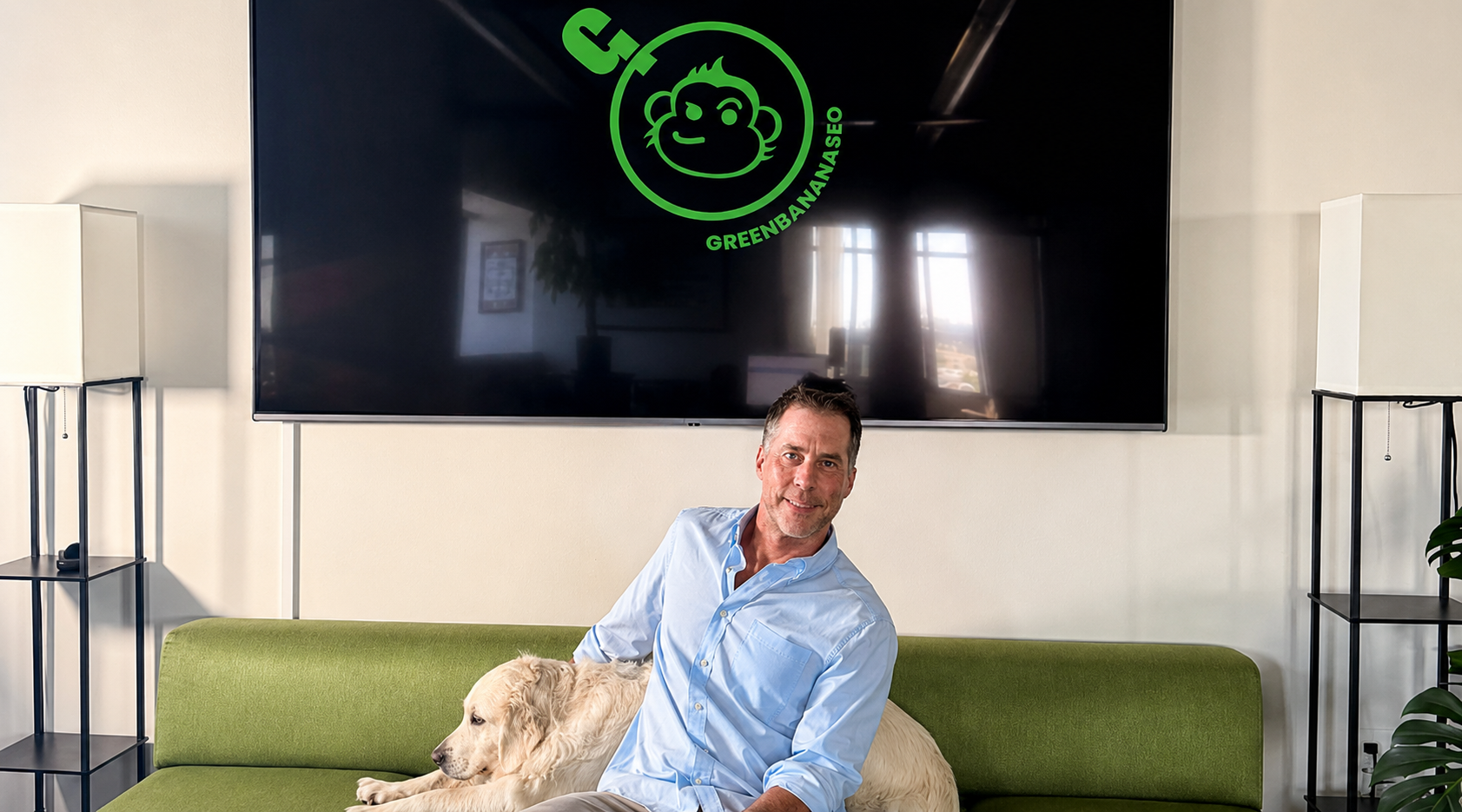
The GreenBanana SEO name came later. I was scheduled to speak about SEO at an engineering conference after the audience had already sat through several dry technical presentations. I abandoned my slides and used a whiteboard to explain how SEO worked, choosing “banana” as a simple example. The only marker I could find was green. People remembered me as “the banana guy,” and the name stuck.
That experience captured what I wanted the company to do: help strong businesses compete by making their value easier to understand. Search has changed dramatically since then, and the work now includes Answer Engine Optimization and AI search visibility. The purpose has stayed consistent. I want to help businesses earn a fair chance to be found and chosen.
How is AI changing your business? What changes are you making to adapt?
AI has changed the central question clients bring to us. They used to ask where they ranked on Google. Now they also ask why ChatGPT omitted them, described them incorrectly, or recommended a competitor. Those answers can influence which companies a customer considers before ever visiting a website.
We adapted by looking beyond whether a page ranks. We now evaluate whether an AI system can retrieve the relevant information, understand the company behind it, find credible support for its claims, and represent it accurately in an answer. That requires a broader view of visibility than a list of keyword positions can provide.
GreenBanana SEO’s own website serves as our live testing ground. We test emerging strategies there before asking a client to invest in them, then bring the approaches that hold up into client work. That process has produced a meaningful business result: one of GreenBanana SEO’s largest clients in the past five years found the agency through ChatGPT. For me, that is far more useful than making predictions about where AI search may be headed. It shows that the work can influence how real customers discover and choose a company.
If AI is impacting your business, please tell us 3 things you expect to change in the near future.
The first change will be how companies plan content. AI search features can use query fan-out, where one prompt leads to multiple related searches across different subtopics and sources. A business will need to demonstrate relevance across more of the customer’s decision process instead of concentrating on one keyword or one page.
The second change will be who pays attention to AI search. As AI systems increasingly shape which companies people consider, inaccurate descriptions, omissions, and competitor recommendations will attract attention beyond the marketing department. Leadership teams will begin treating AI search visibility as part of brand reputation, customer acquisition, and revenue planning.
The third change will be measurement. Rank tracking will remain useful, but companies will also need to know how often they are mentioned, cited, recommended, and described accurately across AI-generated answers compared with their competitors. I call that Share of Answer. I expect it to become a standard business metric as more customer discovery moves into AI interfaces.
What are your greatest 3 skills and how have they helped you succeed?
The first is analytical discipline. Search creates an endless supply of opinions, correlations, and confident predictions. I try to separate what sounds plausible from what the evidence supports. That has helped us avoid chasing every new tactic and focus our resources on changes that can affect visibility and business results.
The second is translating technical ideas into language a business leader can use. Clients do not need a lecture on every part of an algorithm. They need to understand what changed, why it matters to their company, and what decision they should make next. Clear explanations build trust and make complex strategies easier to implement across a team.
The third is financial discipline, including the willingness to say no. At one point, I chose to part ways with several clients who were unprofitable or no longer a strong fit, even though losing the revenue hurt in the short term. That decision created room to build a healthier agency around the work we could perform well and sustain.
Tell us about a time where you saw a surprising outcome that you did not expect.
About a year and a half ago, several larger clients began asking why they were not appearing prominently in answers from ChatGPT and Gemini. My initial assumption was that AI citations would operate as a largely separate system from traditional organic rankings. I expected we would need to solve a new problem from the ground up.
When I reviewed our visibility, I found a much closer relationship than I expected. I could not find an example of GreenBanana SEO earning an AI citation for a topic where we did not already have strong organic visibility. That finding changed how I thought about the sequence of the work.
I handled it by changing the order of our recommendations. Strong organic visibility became a required checkpoint before we pursued work aimed specifically at improving AI citations. That kept us from treating AI visibility as a shortcut around established search fundamentals.
The simple but important lesson was that AI search has changed discovery, but it has not erased the value of technical SEO, useful content, and established authority. Businesses that skip the foundation may create a great deal of new material without becoming a source that an answer engine trusts.
What is the biggest challenge you face each day and how do you handle it?
The biggest challenge is separating durable change from industry noise. AI answer engines and search platforms evolve quickly, and every update produces a flood of claims about what supposedly works. Acting on all of them would waste time and client budgets, while ignoring a meaningful shift could leave a client behind.
I rely on two safeguards. I participate in a peer group of SEO and AEO practitioners from around the world who compare observations and real results. I also protect a block of time each week to review changes, compare evidence, and decide what deserves action. The combination gives me access to a wider range of evidence while preserving the time to form my own conclusions.
What is a habit you try to stick to and how has it helped you?
I try to learn something every day. I read constantly, and I listen to AI and search podcasts most days, even when there is no immediate client issue pushing me to do it. That consistency matters because the most useful insight often comes from connecting several small developments over time rather than reacting to one headline.
The habit has also made me more comfortable changing my mind. When learning is part of the daily routine, new information does not feel like a threat to an established playbook. It becomes another input that can sharpen the questions we ask and improve the recommendations we make.
What achievement are you the proudest of and why?
I am proudest of building GreenBanana SEO into a durable company that has continued to grow through nearly two decades of changes in search and digital marketing. The agency has been recognized on the Inc. 5000 and Massachusetts Fast 50 lists, and those honors matter because they reflect sustained business performance rather than a single campaign or moment.
I am especially proud that the company has kept evolving without losing its practical focus. New technology only matters to our clients when we can turn it into clearer decisions, stronger visibility, and measurable business results. Building a team and an operating model that can keep doing that is the achievement I value most.
Teach our readers something specific to your business. What would that be?
I would teach readers how to audit a page for AI search readiness. Answer Engine Optimization is the practice of organizing a brand’s content, structured data, outside authority, and digital proof so that AI answer engines can find the information, understand it, trust it, and use it when making a recommendation.
The first part of the audit is what I call the Three-Block Blueprint. Near the top of the page, include a direct statement that clearly explains what the page is about. Then provide proof that supports the statement, such as a case study, checklist, comparison, or relevant data. Finally, give the reader a useful next step, such as an FAQ, a related resource, or a clear way to take action.
The next layer is advanced schema, which I explain through an analogy called Schema Mountain. Schema is behind-the-scenes code that gives search and AI systems structured information about a company, including who it is, what it does, where it operates, and how its content connects. Many sites stop with the basic schema generated by a plugin. Moving higher up Schema Mountain means building more complete and connected signals that make the brand easier for machines to interpret.
The final layer is outside corroboration. Reviews, credible media coverage, expert mentions, and other third-party sources help support what the company says on its own website. Traditional SEO provides the base. The Three-Block Blueprint, advanced schema, and outside authority help close the remaining gap between appearing in search and becoming a source an AI engine is willing to cite and recommend.
If you do charity or volunteer work, what is it and why do you do it?
I serve on the board of the Greater Beverly YMCA, near where GreenBanana SEO is based outside Boston. I value the YMCA’s practical role in helping local children and families access programs, support, and a stronger sense of community.
The work also gives me a valuable perspective outside the agency. Running a company can narrow your attention to clients, competitors, and the next business challenge. Board service keeps me connected to the place where I live and gives me a way to contribute my time and experience to an organization with a direct local impact.
Are you willing to be a mentor? If yes, what is the best way to reach you?
Absolutely. Someone was willing to spend time with me early in my career. I like being able to do the same, whether that’s for someone finding their way into SEO or AI search, or a business owner just trying to make sense of it. The best way to reach me is through my website.
Just for fun, what is your favorite food?
That’s a tough one because I grew up on the rocky coast of Massachusetts, so lobster will always have a hold on me. But, if I’m being honest about my actual go-to, it’s a really good burger.
I also love trying the weird combinations restaurants put on their burger menus. One place had an Elvis Burger with peanut butter and banana on it, and I almost skipped it because it sounded terrible, but it was amazing. I’d order it again tomorrow.