
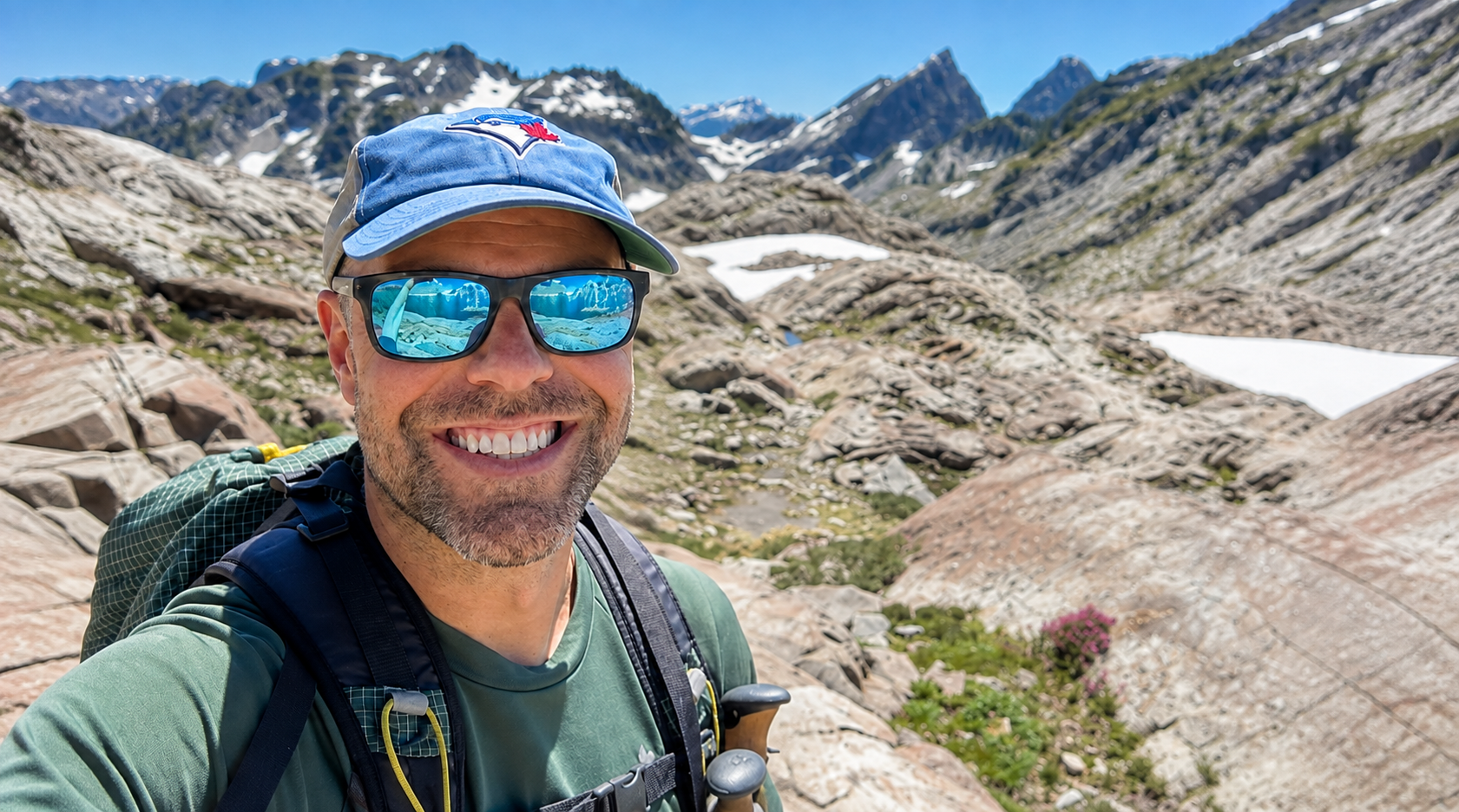
What motivates you when things get tough? Feel free to be detailed and explain why.
The thing that keeps me moving when the business is hard is remembering exactly what I walked away from to do this. I spent years in investment banking and strategy consulting doing work that was intellectually demanding and financially rewarding and almost completely disconnected from anything I actually cared about. I knew what it felt like to be capable and well-compensated and quietly miserable, and that memory is more motivating than any revenue target I could put on a whiteboard.
The specific anchor is a trip I took at 27, thirteen months backpacking across five continents after walking out of a banking job with no plan beyond moving. That period showed me what it felt like to be fully engaged with something, genuinely uncertain about the outcome, and learning faster than I ever had inside a structured career. Running The Broke Backpacker on a hard day still feels more alive than a good day in a corporate conference room, and that comparison is enough to keep going.
Tell us 3 surprisingly easy and 3 surprisingly difficult things about your business.
Getting the editorial team to adopt higher content standards was easier than I expected, because experienced travel writers already have an internal quality bar and mostly need a concrete definition to align around, not a lecture.
Generating content ideas has also never been a problem, because a library of 1,000+ guides and eleven years of reader emails tells you exactly which questions still don’t have a good answer anywhere on the internet.
Staying personally connected to the mission has been the easiest thing of all, because when your subject is hitchhiking through Kyrgyzstan or crossing into Myanmar on a $30-a-day budget, motivational problems are rare.
Keeping 1,000+ existing guides accurate has been harder than anything I anticipated, because a hostel closes, a visa policy changes, or a border crossing that worked fine in 2022 becomes a bureaucratic wall and suddenly the advice we published is sending someone in the wrong direction.
Managing organic traffic through back-to-back Google core updates has been brutal in a different way, because each update rewarded completely different signals and the playbook that worked six months ago actively hurts you today.
Earning the trust of a reader community that spent a decade loyal to Will Hatton specifically has been the most delicate challenge, because one wrong editorial call in the first year could fracture something that took eleven years to build.
What are the 3 things you like best about your work and why?
The feedback loop is immediate and unambiguous. When we publish a guide to crossing the Iran-Turkey border overland on a tight budget and a reader emails three weeks later saying it was the only resource that gave them accurate cost breakdowns and current checkpoint information, I know the work landed. That directness did not exist in consulting, where the gap between a recommendation and its real outcome was measured in fiscal quarters.
The second is that the research makes me a sharper traveler in real time. Improving our Appalachian Trail thru-hiking coverage means going deep on resupply strategies, gear decisions for specific terrain conditions, and weather windows that most day-hiker guides completely ignore. That knowledge is directly usable the next time I am on the trail, which means the job and the life I want to live are feeding each other rather than competing.
The third is solving problems that actually matter to the reader. A 24-year-old flying into Kathmandu with $900 and six weeks is not looking for aspirational photography. She needs to know which trekking permits changed price last month, which teahouse routes are currently passable, and what happens if she gets altitude sickness three days from the nearest road. Getting that answer right for her, specifically, is the part of the work that makes everything else worth doing.
What are your greatest 3 skills and how have they helped you succeed?
Structured problem-solving from my years at Bain is the skill that shows up most in how I run the business. When organic traffic dropped after a Google core update, I didn’t panic and start publishing more content. I broke the problem into its components, identified which guide categories took the hardest hits, traced the pattern back to specific content characteristics, and built a remediation plan around those findings. Consulting trained me to separate symptoms from causes, and that discipline saves an enormous amount of wasted effort in a business where the temptation to react emotionally to algorithm changes is constant.
The second is knowing how to read an audience with specificity. Thirteen months of firsthand backpacking across five continents gave me an instinct for what a broke traveler actually needs versus what sounds helpful from the outside. When I review a guide, I can tell within a few paragraphs whether the writer has been to the place or assembled the piece from other websites, because the details that matter to someone on the ground are completely different from the details that look comprehensive in an outline.
The third is being comfortable making decisions with incomplete information, which investment banking forced on me early. Buying a content site in 2024 when AI was actively disrupting search was not a decision anyone could model to certainty. Knowing how to assess downside risk, identify the assumptions that matter most, and commit to a direction without waiting for perfect clarity has been the skill that made the acquisition possible and keeps the business moving forward on days when the landscape shifts again.
Tell us about a time you were dead wrong about something.
When I first took over The Broke Backpacker, I was convinced the fastest path to stabilizing traffic was publishing more content at a higher rate. The logic seemed sound: more guides meant more indexed pages, more indexed pages meant more surface area for search, and more surface area meant more chances to recover the ground we had lost. I pushed the team hard in that direction for the first few months and watched the results go sideways. Traffic didn’t recover and several of the new guides we rushed out were noticeably thinner than the standard the site had built its reputation on.
What I got wrong was assuming a volume problem when it was actually a quality problem. The guides that were losing traffic weren’t losing it because we had too few of them. They were losing it because Google’s updated systems were getting better at identifying content that covered a topic without genuinely answering the reader’s question. The fix wasn’t more pages. It was going back into our existing top guides, gutting the sections that said nothing useful, and replacing them with information that could only come from someone who had actually been to the place. That correction cost us two months of publishing momentum and taught me that in content, the instinct to produce your way out of a problem is almost always wrong.
What is the biggest challenge you face each day and how do you handle it?
The hardest daily challenge is making editorial prioritization calls with limited resources and unlimited competing demands. On any given day there are guides that need updating because a visa policy changed overnight, new content opportunities that align with what readers are actively searching for, and existing pages that are losing traffic for reasons that require real diagnostic work to understand. All of it feels urgent and none of it can all get done at the same time with a lean remote team.
The way I handle it is by starting every morning with one question: which single piece of work, if completed today, has the highest chance of meaningfully helping a reader who is actively planning a trip right now. That filter cuts through the noise faster than any prioritization framework I brought over from consulting, because it forces every task to justify itself against the actual mission rather than against internal metrics that can be gamed.
What is a habit you try to stick to and how has it helped you?
Every week I read at least five reader emails or comments in full, not skimmed summaries, not flagged highlights from the team, the actual unedited messages from people who used our content and wrote in to tell us what happened. A traveler who followed our Pamir Highway guide and hit a checkpoint we hadn’t warned about. Someone who used our packing list for a Southeast Asia trip and found three items that were wrong for the climate they actually encountered. A reader who crossed a border we described as straightforward and found it had been closed for two months.
That habit has kept me editorially honest in a way that dashboards and traffic reports cannot. Numbers tell you that a guide is underperforming. Reader emails tell you exactly why, in language that makes the fix obvious. It also keeps the work from becoming abstract, because when you are reading about a real person’s experience on the ground with advice you published, the stakes of getting it right stop feeling like a content strategy problem and start feeling like the actual responsibility it is.
What achievement are you the proudest of and why?
The achievement I keep coming back to is completing the acquisition itself, not because buying a business is inherently impressive, but because of what it required me to walk away from to do it. I left a stable, well compensated corporate career at a point where most people around me thought the sensible move was to keep climbing. Choosing to buy a travel content site in 2024, during one of the most disruptive periods in the history of digital publishing, was not a decision that had obvious logic from the outside.
What makes me proud of it is not that it has been easy or that every bet has paid off. It is that the decision was genuinely mine, made for reasons I can defend, and it put me in charge of something I actually care about. I spent 13 months backpacking across five continents at 27 and came back knowing that the work I would eventually be most proud of would have to feel like that, uncertain, hands on, and connected to something real. Running The Broke Backpacker is the closest I have come to that standard inside a business, and that alignment matters to me more than any metric I could point to.
What is your favorite book and why?
The book I come back to most is “The Obstacle Is the Way” by Ryan Holiday, which builds its argument around a single Stoic idea: the thing blocking you is the thing that teaches you what you actually need to know. I read it for the first time during a stretch of the Appalachian Trail where I was dealing with a knee injury that was threatening to end the thru-hike, and the framing hit differently when the obstacle was physical and immediate rather than abstract and theoretical.
What has made it stay with me through the acquisition and the hard early months of running The Broke Backpacker is that it does not offer comfort. It offers a way of orienting toward difficulty that makes difficulty useful rather than just painful. Every time a Google update hits or a content strategy stops working, the instinct is to treat the disruption as an interruption. Holiday’s argument is that the disruption is the curriculum, and I have found that reframe genuinely practical in a business environment where the ground shifts constantly.
What advice would you give to your younger self and why?
Leave sooner. I waited until I was 27 to walk out of the banking job and spend thirteen months traveling, and even that felt late by the standards of the person I was trying to become. The years I spent before that trip doing work that didn’t matter to me were not wasted exactly, the skills transferred and the financial discipline funded the travel, but the cost was a version of myself that had gotten very good at performing capability while quietly ignoring what I actually wanted to build.
The advice is not to quit everything and travel, though that worked for me. It is to make the decision you already know you need to make about six months before you currently plan to make it. The arguments for waiting are almost always about risk management, and they are almost always wrong, because the real risk is spending another year optimizing a life that was never quite the one you wanted.
Who has been your biggest mentor in life (personal or professional) and how have they helped you?
The most formative professional influence was the environment at Bain rather than a single person, specifically the culture of asking what problem you are actually solving before committing to how you will solve it. That discipline of separating diagnosis from prescription sounds simple and is genuinely hard to maintain when a business is under pressure and the instinct is to act rather than think. Every senior person I worked with at Bain reinforced that habit in different ways, and it has shaped every significant decision I have made since, including the acquisition.
On the personal side, the traveler who has influenced me most is Will Hatton himself, not as a mentor in the formal sense but as proof of concept. He built something real and lasting by going to difficult places, telling the truth about what he found, and trusting that an audience existed for that kind of honesty. Inheriting his platform and his reader community has been its own form of mentorship, because the standard he set is visible in every guide on the site and it raises the bar for everything we publish under his name and mine.
Just for fun, what is your favorite food?
A bowl of proper ramen in Japan, specifically the tonkotsu variety I had at a counter stall in Fukuoka where the broth had been running for what felt like decades and the chashu pork dissolved before it needed to be chewed. I have eaten in a lot of countries across five continents and that bowl remains the clearest food memory I have from any of them.