
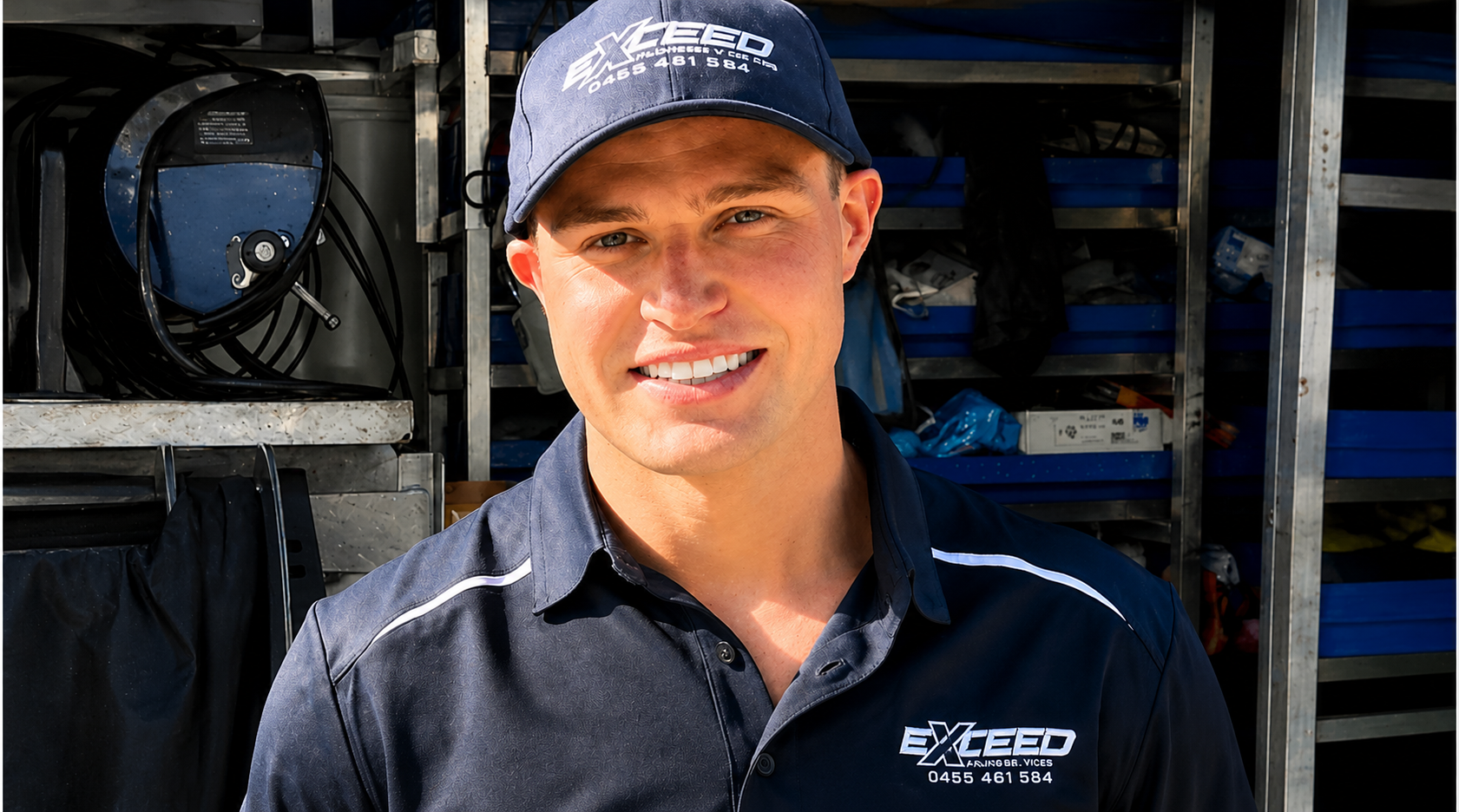
What made you want to do the work you do? Please share the full story.
Honestly, it started with frustration more than anything else.
I spent years working under other businesses in the trade, and the pattern I kept seeing bothered me. Customers would call for help, someone would show up late or not at all, the work would get done halfway, and nobody seemed to care enough to follow through. I watched homeowners get charged full price for jobs that weren’t finished properly, and when they called back to complain, they’d get the runaround.
That got under my skin. Not in a dramatic way, but in the quiet, steady kind of way that builds over time until you can’t ignore it anymore.
I grew up believing that if someone trusts you enough to let you into their home, you owe them your full attention and your best work. That’s not a complicated standard. Show up when you say you will. Do the job right. Leave the place cleaner than you found it. Be straight with people about what they need and what it’s going to cost. Those things aren’t hard, but I kept watching businesses treat them as optional.
So after about a decade in the trade, I started Exceed Plumbing & Air Conditioning because I wanted to build something where those standards weren’t optional. Where a customer calling about a blocked drain or a hot water system that had stopped working at 6am could actually rely on the person coming out to fix it.
For me, the work itself has always made sense. There’s something satisfying about a problem you can diagnose, fix and walk away from knowing it won’t fail again because you did it properly. Plumbing and air conditioning are like that. The feedback is immediate and honest.
But what really keeps me doing it is the customer side of things. I think about the homeowner who’s been let down before, who picks up the phone half-expecting to be disappointed again, and what it means to actually show up and change that experience for them. That’s the part that doesn’t get old.
How is AI changing your business? What changes are you making to adapt?
That’s a question I’ve been thinking about a lot lately, to be honest.
The most immediate change I’ve noticed is on the customer side. People come to us now having already done a serious amount of research before they pick up the phone. They’ve looked up what a pipe relining job should cost, they’ve read about the difference between a heat pump and a gas hot water system, they’ve watched videos on what CCTV drain inspection actually involves. In my experience, that’s mostly a good thing. It means the conversation starts at a higher level and we spend less time on basics.
But it also means we have to be sharper. If someone has done their homework and the person they call can’t speak to the detail with the same level of confidence, that gap shows immediately.
On the business side, I think AI is changing how trades businesses like ours handle the admin and communication load. Scheduling, follow-ups, responding to enquiries after hours, pulling together quotes. Those things used to eat up a significant chunk of time. There are tools now that handle a lot of that load, and for a business our size, that matters because every hour saved on admin is an hour that goes back into the actual work.
The adaptation we’re focused on right now is making sure our knowledge stays ahead of what people can find on their own. Anyone can get a general answer these days. What they can’t get from a search is someone who has physically been under their house, looked at their specific drain configuration and told them exactly what’s going on. That hands-on diagnostic piece is where the trade still has something no tool can replicate.
So I guess the honest answer is: AI is raising the bar for how prepared and responsive a trade business needs to be, and we’re treating that as something worth keeping up with rather than ignoring.
If AI is impacting your business, please tell us 3 things you expect to change in the near future.
Three things I genuinely expect to shift in the near future.
The first is customer expectations around response time. Right now, most people are still okay with a callback within a few hours. I don’t think that window stays open much longer. AI-powered booking and enquiry tools are training people to expect an immediate response at any hour, and trades businesses that still run on a “we’ll call you back in the morning” model are going to feel that gap. We’re already looking at how we handle after-hours contact because of this.
The second is quoting and diagnostics. I expect AI tools to get good enough, fairly soon, that a homeowner can upload a photo or short video of a problem and get a reasonably accurate assessment of what’s wrong and what it should cost to fix. That changes the dynamic of the first conversation we have with a customer. They’ll arrive with a baseline expectation already set, and our quote either confirms it or we’d better have a clear reason why it doesn’t. The businesses that adapt their quoting process to that reality early will be in a better position than the ones who get caught off guard by it.
The third is trade skills documentation. In my work, a lot of what experienced tradies know lives in their heads and nowhere else. Diagnostic instincts built over years on the job, the kind of pattern recognition that tells you a blocked drain isn’t just a blockage but a sign of root intrusion three metres down. I think we’re moving toward a period where that knowledge needs to be captured and structured, partly because AI tools are only as useful as the information fed into them, and partly because the skills gap in the trades is real and getting wider. The businesses that figure out how to document and transfer that knowledge internally are going to build something more durable than the ones that don’t.
What are your greatest 3 skills and how have they helped you succeed?
Three skills that have genuinely made a difference, and I’ll be straight about why.
Reading a situation before I touch anything.
In the trade, the instinct to jump straight into a fix is strong, especially when a customer is stressed and wants the problem gone. But the best thing I ever learned was to slow down in the first few minutes and actually read what’s in front of me. A blocked drain isn’t always just a blocked drain. Sometimes it’s the third symptom of a root intrusion problem that started two metres away, and if you treat the symptom without finding the source, the customer is calling you back in six weeks with the same issue. That diagnostic patience has saved customers money and saved us from callbacks that would have cost us our reputation.
Communicating what’s actually happening in plain language.
Most people don’t speak trade. They don’t know what pipe relining means or why a heat pump hot water system costs more upfront but less over time. Early in my career I underestimated how much that communication gap affected trust. People don’t just want the job done. They want to understand what they’re paying for and why. Getting good at explaining technical problems in plain, honest language changed the way customers experienced working with us, and a lot of our repeat business and referrals trace back to that.
Following through when it would be easier not to.
This one sounds simple but I think it’s rarer than it should be in any industry. Showing up on time, calling when you said you would, going back to check a job held up properly. Those habits compound over time into something that’s hard to build quickly and very hard for a competitor to copy. For me, the reputation we’ve built at Exceed Plumbing & Air Conditioning sits almost entirely on that consistency. Not on being the flashiest or the cheapest, but on being the ones people can actually count on.
Tell us about a time where you saw a surprising outcome that you did not expect.
This one still comes to mind regularly because it genuinely caught me off guard.
A few years back we got called out to a home where the homeowner was convinced she needed a full hot water system replacement. The unit was about eight years old, it had stopped producing consistent hot water and she’d already mentally budgeted for a new system. She was frustrated, she’d been dealing with it for about two weeks and she’d called us half-expecting to hear a big number.
I went through the system methodically before assuming anything. And what I found was a failed thermostat and a sediment build-up around the element that was causing the unit to cut out under load. Not a new system problem. Not even close.
The fix took about an hour. The parts cost was modest. We walked away having charged her a fraction of what a replacement would have cost, and she was almost confused by it. She kept asking if we were sure that was all it needed.
That part I expected to feel good about. What I didn’t expect was what happened next.
She called us back three times in the following year for completely unrelated jobs. Her sister became a customer. Two of her neighbours called us after she mentioned us at some kind of street gathering. That one honest hour of work, where we could have easily pushed a full replacement and nobody would have questioned it, turned into more referral business than some of our larger jobs ever produced.
I think about that job a lot when I’m training someone new. The surprising outcome wasn’t the repair itself. It was the reminder that doing the right thing by a customer, even when the easier and more profitable option is sitting right in front of you, pays back in ways you genuinely can’t predict or plan for.
What is the biggest challenge you face each day and how do you handle it?
Honestly, it’s managing the gap between what a day is supposed to look like and what it actually becomes.
In the trades, you can plan a day reasonably well. Jobs are booked, times are set, the team knows where they’re supposed to be. And then a burst pipe call comes in at 7am, or a job that was quoted as two hours turns into five because what’s behind the wall wasn’t what anyone expected. That ripple effect moves through the whole day and suddenly you’re calling customers to push their appointment back and managing their frustration on top of everything else.
For a long time I tried to solve that by over-planning. Tighter schedules, more buffer time built in, more detailed pre-job checklists. Those things helped but they didn’t fix the core problem, which is that the trades are inherently unpredictable and no amount of planning fully absorbs that reality.
What actually changed things for me was shifting how I thought about communication. The frustration customers feel when a job runs late isn’t usually about the delay itself. It’s about not knowing. People can handle a two hour pushback if they hear about it early and get a clear update. What they can’t handle well is silence followed by a late arrival with no explanation.
So the way I handle it now is by treating communication as part of the job, not a distraction from it. If something changes, the customer hears about it before they have to chase us. That one shift took more pressure off the day than any scheduling system I ever tried.
It doesn’t make the unpredictability go away. But it changes what that unpredictability costs us in terms of trust, and that’s the part that actually matters.
What is a habit you try to stick to and how has it helped you?
One habit that I’ve held onto for a long time is doing a quick debrief in my head at the end of every job before I leave the site.
It takes maybe two or three minutes. I walk back through what I found, what I did, whether the fix addressed the actual problem or just the visible symptom, and whether there’s anything the homeowner should watch for down the track. Then I have a short conversation with the customer before I go, not a formal rundown, just a plain language summary of what happened and what they should know going forward.
Most tradies skip that part. The job is done, the tools go in the van, and that’s it. I get why. The day is long and there’s usually somewhere else to be. But I kept noticing early in my career that customers who got that two minute conversation at the end felt more confident about the work than customers who didn’t, even when the job itself was identical.
That habit has done a few things for me over time. It catches things I might otherwise miss in the rush to move on. It gives the customer something concrete to hold onto instead of just a bill and a fixed problem they don’t fully understand. And it’s become the moment where, more often than not, they mention something else in the house they’ve been meaning to get looked at.
Not because I’m prompting them to. But because a calm, clear two minute conversation at the end of a job creates exactly the kind of trust where people feel comfortable bringing something else up.
It’s a small habit. But in my experience, the small consistent ones tend to build more over time than the big occasional efforts ever do.
What achievement are you the proudest of and why?
Honestly, it’s not a single job or a milestone number. It’s something quieter than that.
The achievement I’m proudest of is building a business where the people who work with us actually want to be here, and where customers call back not because we’re the cheapest option but because they trust us. That took longer to build than I expected and it nearly came apart a couple of times along the way.
There was a period about three years in where we were growing faster than our systems could handle. We were taking on more work than we could deliver at the standard I’d built the business around, and I could feel the quality slipping. Jobs were getting rushed. Follow-through was inconsistent. I was so focused on the volume of work coming in that I stopped paying close enough attention to what was going out.
I made the decision to pull back. We turned down work for about four months while we rebuilt the internal processes, retrained, and got the team back to a place where I was confident in what we were producing. That was a hard call financially and I second-guessed it more than once.
But what came out the other side was a business that felt like what I’d originally intended it to be. Reliable. Consistent. Something I could put my name on without hesitation.
The proudest moment wasn’t the growth. It was having the discipline to slow down and protect the thing that made the growth worth having in the first place. For me, that decision defined what Exceed Plumbing & Air Conditioning actually stands for more than any single job or revenue figure ever could.
What is your favorite movie and why?
The one that has stayed with me longest is “The E-Myth Revisited” by Michael Gerber.
I picked it up probably five or six years into running Exceed Plumbing & Air Conditioning, at a point where I was exhausted and couldn’t quite figure out why the business felt like it was running me instead of the other way around. Someone in my network mentioned it and I read the whole thing in about two sittings.
The central idea is something I wish I’d understood earlier. Gerber draws a distinction between the person who is good at a trade or a skill, and the person who can actually build a business around that skill. He calls it the difference between working in your business and working on it. Most tradespeople, most small business owners really, start out because they’re good at something. But being good at the work and being good at building a system that delivers that work consistently are two completely different capabilities.
That framing cracked something open for me. It explained exactly why the early years felt so chaotic. I was showing up every day as the plumber, solving problems on the tools, and wondering why the business side of things never quite got traction. I hadn’t made the mental shift to also being the person responsible for building the structure around the work.
It’s not a perfect book and some of it is dated. But the core question it asks, which is essentially whether your business could run without you, is one I still come back to regularly. For me it moved from being a book about business to being a book about how I think about what I’m actually building and why that distinction matters.
If you do charity or volunteer work, what is it and why do you do it?
Nothing formal on the charity side, and I’d rather be straight about that than dress it up into something it isn’t.
But there is something we do that I think sits in that space, even if it doesn’t carry a charity label.
A few times a year we get calls from people who are clearly doing it tough. Older homeowners on fixed incomes, single parents dealing with something urgent they genuinely can’t afford, people who’ve just had a run of bad luck and a burst pipe or a failed hot water system is the last thing they needed on top of everything else. In those situations we make a call on the spot about what the job actually needs to cost for that person.
Sometimes that means charging for parts and absorbing the labour. Sometimes it means showing someone how to manage a minor issue themselves so they don’t need us to come back for it. We don’t advertise that and we don’t have a formal policy around it. It just happens when it happens and the team understands that’s part of how we operate.
The reason I keep doing it traces back to why I started the business in the first place. I got into this because I watched too many people get taken advantage of at moments when they were already stressed and vulnerable. Charging someone full rate when you can see they’re genuinely struggling, and the job allows for flexibility, has always felt like exactly the kind of thing I set out not to do.
It’s not grand. But I think the small decisions you make when nobody is watching and there’s no PR value in it say more about what a business actually stands for than the ones made in public.
Are you willing to be a mentor? If yes, what is the best way to reach you?
Yes, genuinely open to it.
Mentoring isn’t something I’ve formalised but it’s something I’ve done informally for a while now, mostly with younger tradies who are thinking about making the leap from working for someone else to running their own operation. That transition is harder than most people expect and I remember clearly what it felt like to navigate it without much guidance.
If I’m being real, the questions I find most useful to work through with someone are the ones that don’t have a clean answer. Not “how do I register a business” because that information is everywhere. More like “how do I know when I’m ready,” “how do I handle a customer who’s trying to push my price down,” or “how do I keep the quality consistent when I’m tired and the day has already gone sideways.” Those conversations I’m genuinely happy to have.
The best way to reach me is directly through the Exceed Plumbing & Air Conditioning website at exceedplumbing.com.au. Send a message through the contact page, mention that you’re reaching out about mentoring and I’ll get back to you personally. I’m not always fast because the days get full, but I do respond.
I’d just ask that anyone reaching out comes with a specific situation or question rather than a general request for advice. Not because I’m not willing to help but because a focused conversation tends to produce something more useful for both people than a broad one does. The more concrete the question, the more concrete the answer I can give.
Just for fun, what is your favorite food?
Hands down, it’s a really good beef burger. Nothing fancy, nothing trying too hard. Just a proper patty with some char on it, melted cheese, pickles, a bit of mustard and a bun that holds together without falling apart after the second bite.
I think what I love about it is how straightforward it is. You know exactly what you’re getting and when it’s done right, nothing beats it. I’ve had meals at restaurants that cost ten times more and walked away less satisfied.
My personal rule is that the best burgers almost never come from the places with the nicest fit-out. It’s usually some small, no-frills spot that’s been doing the same thing the same way for years and just got really good at it.